Skip to content


Activity based Space Education

ROVER - Education Training Program

Robotic Observation Vehicle for Extraterrestrial Research — From Class to Cosmos.Hands-on rover building, wiring, driving and exploration skills for students across Karnataka.

ROVER stands for Robotic Observation Vehicle for Extraterrestrial Research. The ROVER Training Program introduces students to the engineering behind planetary rovers used by spacecraft agencies like NASA and ISRO. Our goal is to make space education hands-on, playful and deeply educational.

  • Target: School students across Karnataka.
  • Method: Team-based assembly, wiring, testing and driving.
  • Outcome: Each student assembles, drives and troubleshoots a working rover.


Why hands-on?

Children learn faster when they tinker. We encourage safe mistakes, iteration and curiosity so that creative problem solving and engineering thinking become intuitive.

Curriculum & Modules

Curriculum is modular and activity-centric. Sessions can be 1-day workshops, 3-day intensive camps or extended after-school modules.

Module 1 — Introduction to Rovers

History of planetary rovers, how NASA & ISRO operate rover missions, mission objectives and rover subsystems.

Module 2 — Mechanics & Drive Systems

Build chassis, fit wheels, learn 2‑wheel, 4‑wheel and 6‑wheel drive architectures, steering and rotation mechanics.

Module 3 — Electricals & Wiring

Battery safety, wiring DC traction motors, motor controllers, switches and power distribution for small rovers.

Module 4 — Sensors, Camera & Arm

Stepper motor control for camera arms, basic camera modules, mounting and simple autopilot / remote control techniques.

Module 5 — Control & Drive Modes

Manual vs assisted driving, differential steering, programming simple drive routines and operator training for safe rover handling.

Module 6 — Team Project & Test Track

Students design a mission, build a rover as a team, and complete test-track challenges including obstacle negotiation and payload delivery.
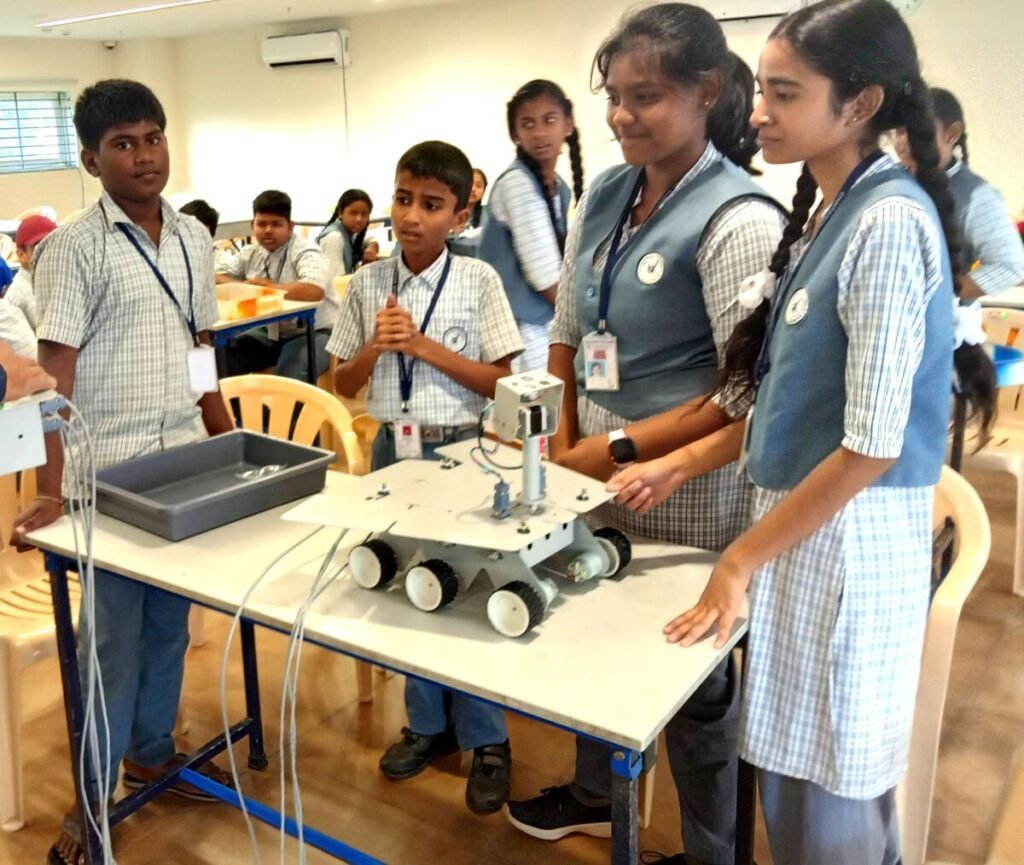
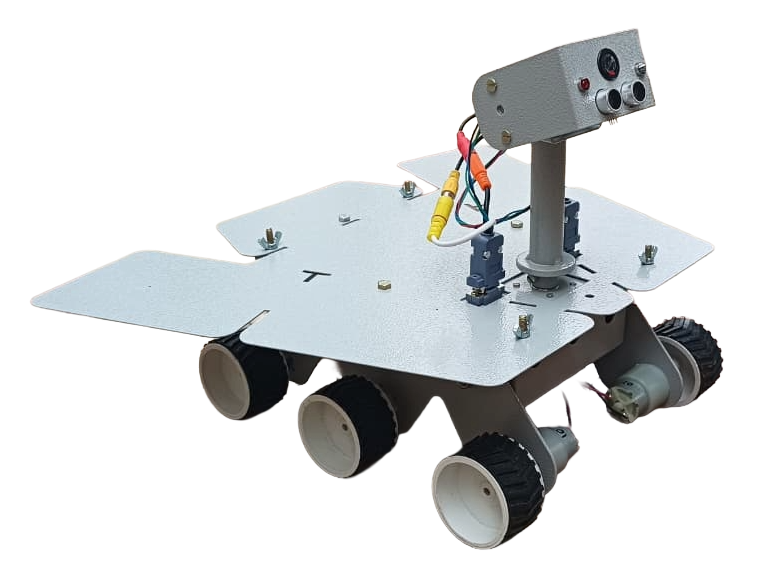
Hands-On Experience

Each team receives two trays: one with mechanical components (wheels, chassis parts, nuts, bolts, motors) and another with tools (screwdrivers, spanners, wire strippers). Participants are guided through safe assembly and encouraged to iterate and learn from mistakes.

Build

Assemble chassis, mount drive trains and attach wheels.

Wire

Wire motors, battery and controllers with safety best-practices.

Drive

Students take turns driving their own rover, testing drive modes and steering strategies.

Question: Age Group

What age groups are eligible?

Typically 8–17 years. Modules are adjusted for different age groups.

Question: Specilist Equipments?

Is specialist equipment required?

We provide all components and tools. Schools only need to provide a safe workspace.

Children build rover on their own?

Can Children build Rovers on their own?

Yes. It is possible. Children can develop skils when given task like building rover. Our rover kits are designed from scratch to provide intuitive learning experience..

Learning Outcomes!

  • • Understanding of rover subsystems and mission objectives
  • • Practical skills in mechanical assembly and wiring
  • • Experience with traction and stepper motors
  • • Teamwork, documentation and iterative design
  • • Confidence in testing, troubleshooting and safe operation
  • • Inspiration to pursue STEM and space technology

Schedule sessions / Contact & Connect

For sessions, collaborations and district tours:

Mars HomeBase Organization

Bangalore, Karnataka

email: training@mhbo.org